Being in a band isn’t just about music.
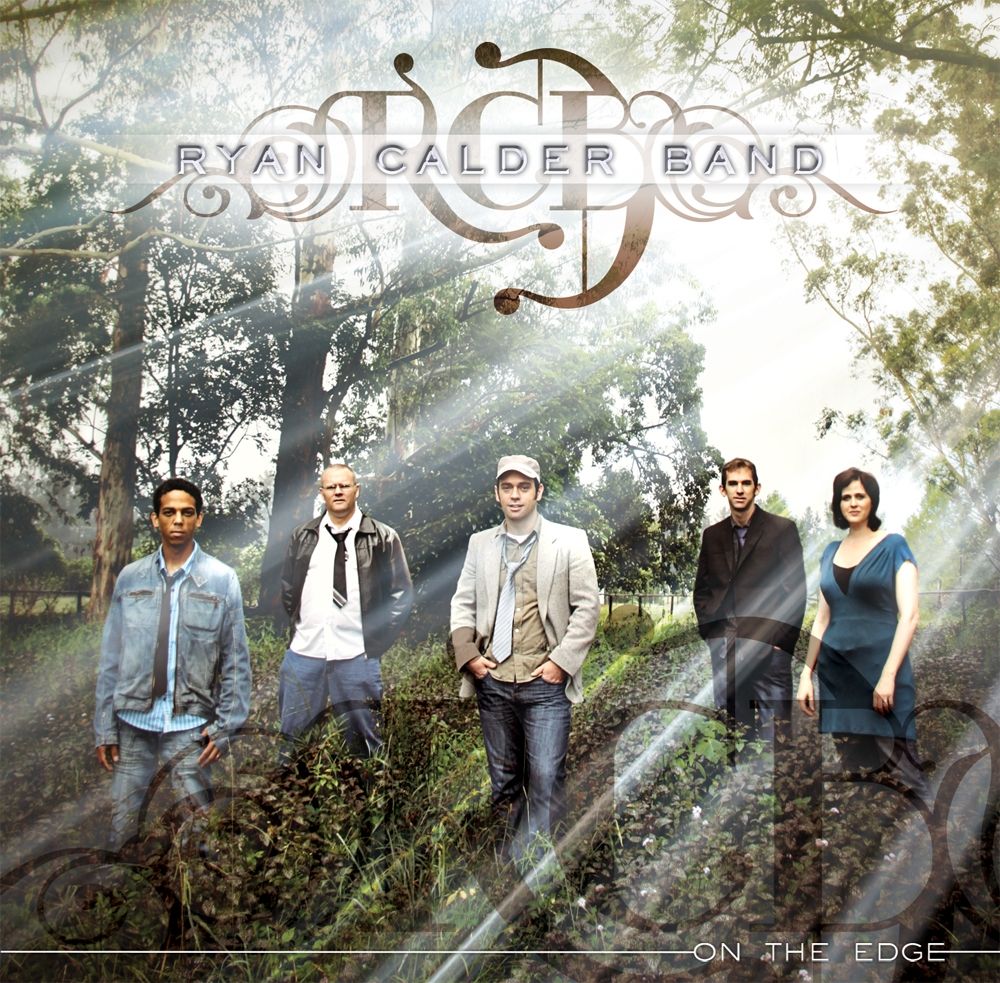
For me, it was always about people. The kind of people who don’t just make you a better musician, but who inspire you to be a better husband, father, and human being. That was the heartbeat of The Ryan Calder Band.
By the time we got to On The Edge, we had already logged countless hours together — on stages, in studios, and most memorably, in late-night conversations about life, family, and the curious choice of devoting your “free time” to making music when you had, you know… responsibilities.
Roberto Hemmero and I had already walked a long road together. He’s adventurous — in music, in life, and in trusting my harebrained ideas. Though we came from very different backgrounds, from day one it was clear: our values lined up. Family, faith, integrity — that was our common ground. The same was true for Rudi — a man whose drumsticks are as precise as his life priorities. These were guys who didn’t just show up to play a gig. They showed up for life. They were young husbands and fathers, just like me. But they were better. And that mattered.
We had performed together multiple times since Splashy Fen, growing not just as musicians but as a band of brothers. So when the idea of a full-band album came up, it wasn’t a question of if, but when — and more crucially, how the heck are we going to pull this off with day jobs and diapers in the mix?
Enter Marlon Hemmero: The Unsung Hero of This Madness
Roberto’s brother, Marlon, is one of those people who somehow believes in you more than you believe in yourself. When I approached him about recording the next album, I was prepared for a polite “I’d love to, but…” Instead, I got: “Let’s do it.”
Just like his brother years before, Marlon agreed to take on my wild ideas and my not-so-wild recording skills. This, dear readers, is a level of friendship that deserves a monument.
Our first recording session was at the Hexagon Theatre’s recording studio. Soundproof acoustics? Tick. Cool factor? Tick. Logistics? Oh boy. Setting up gear in that space turned out to be an Olympic sport. Every session felt like moving house. It didn’t take long before we collectively decided, “This is madness. Let’s move the operation to Marlon’s house.”
BUT… that came with its own set of challenges. Like keeping the noise down so we didn’t annoy the neighbours. And recording at night because — surprise! — we all had day jobs to pay for things like rent, nappies, and, ironically, the very music gear we were using.
Late Nights, Day Jobs, and Laying Foundations
We began in the South African summer of 2009 — those sticky, sweltering November and December months where the only thing hotter than the weather was our sheer determination.
Night after night, Rudi and I would meet with Marlon to lay down drum tracks — the foundation of every song. Rudi’s commitment was phenomenal. He was a new dad, juggling work and family, yet he showed up, sticks in hand, ready to lock in that groove.
From there, we began to build. Jon, our keyboard maestro, flew up from Cape Town between university lectures. I’m not sure what kind of persuasion tactics I used, but somehow he agreed to this mad schedule. Roberto would come after work hours to lay down bass lines, often after full days of managing clients and being an adult.
Every session was a balancing act. A juggling routine of time, energy, and resources. But it felt like I was chiselling away at something far bigger.
The Calder Household: New Rhythms, Same Crazy Dream
For Tamlyn and me, life was moving at double speed. We were new parents, living in a modest two-bedroom apartment in Pelham, Pietermaritzburg. I was working long hours as a journalist, while Tam was a high school teacher. Parenthood was a whirlwind of sleepless nights, early morning feeds, and trying to establish new rhythms as a family.
Unlike the making of Better Days, Tamlyn wasn’t sitting in the studio with me for hours, tolerating my endless EQ tweaks. This time, her stance was clear and non-negotiable: “Hell no… I’ll come in and sing what I need to between working full-time and breastfeeding.”
It was the first time I really felt how music — for all its beauty — could wear you down. It’s expensive, it’s time-consuming, and when you’re DIY-ing every inch of it, it can break you if you let it. I began to understand why so many people simply stop making music after a certain point. It’s not because they don’t love it anymore. It’s because life demands so much — and the return on investment (at least financially) is, let’s say, niche.
But somehow, deep down, I couldn’t stop. My dreams felt like they were tied to a horse that would never tire. Even when I was physically exhausted, there was an intrinsic force propelling me to make it happen — come what may.
The Hustle Behind The Music
By this time, I’d learned a lot. About recording, about production, about the music industry’s fine print that no one really tells you about until you’ve already been burned. I read everything I could find about royalties and rights. I schooled myself on websites, online distribution, and marketing strategies.
I had a vision — not just for the music, but for the entire aesthetic. I knew what the album cover would look like. I knew which photographer I wanted. I even knew how the website would flow. The plan was all there.
But the plan didn’t make it less of a slog. It was a *&^% load of work.
We recorded late into the nights, edited during lunch breaks, and pieced the whole thing together in stolen pockets of time between work, family, and the daily grind of adulting.
Was It Worth It?
That’s the big question, isn’t it?
Was it worth the late nights, the financial strain, the stress, the uphill battle of doing it all ourselves? Was it worth pouring every spare ounce of energy into a project that, in the grand scheme of life’s practicalities, wouldn’t pay the rent or put food on the table?
For a long time, I wasn’t sure how to answer that.
But recently, I was listening to Paul Simon in an interview. He said something that stuck with me. He said that songs aren’t really finished when you write them. They’re completed when someone listens to them and makes up their own mind.
Music is a conversation. It’s not just me, holed up in a studio with my mates obsessing over snare tones and vocal takes. It’s not about the CD cases or the website designs. All of that — the sweat, the cost, the logistical insanity — that’s just the vehicle.
The real “completion” of On The Edge didn’t happen when we mastered the final track. It happened later, quietly, when someone pressed play.
It happened when a young couple messaged me saying asking Tam and I to sing “More Beautiful Tonight” at their wedding. When a guy emailed to say “Leave It Behind” helped him through a rough patch. When someone told me, over coffee, that “Wide Open World” made them rethink a situation in their own life.
That’s when the songs became theirs. That’s when I realised — that’s the whole point.
Music, at its core, is about connection. It’s about building a bridge from your little world to someone else’s, even if it’s just for three minutes and thirty-five seconds. And if even one person walks across that bridge and finds something meaningful on the other side — then yes, it was worth every sleepless night.
The world doesn’t need more noise. But it always needs more meaning.
That’s why we did it.